








Stainless Steel Tariff: What Happens When China’s Price Advantage Meets Tariff Stacking?
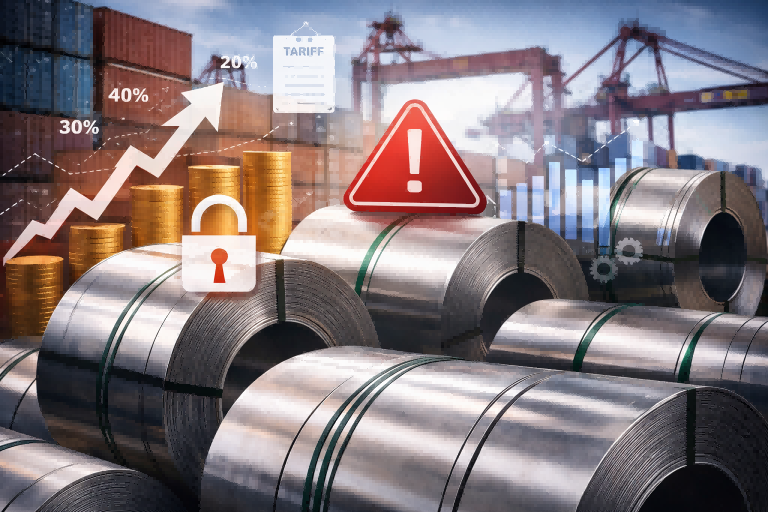
You chose Chinese stainless steel for one simple reason: price.
But when tariffs start stacking, what happens next?
The advantage of Chinese stainless steel has never been complicated:
price, capacity, and consistency.
But by 2026, more buyers are noticing a shift:
The quote still looks competitive —
yet the project outcome is becoming increasingly uncertain.
Some orders lose margin step by step during calculation.
Others only reveal the real cost during customs clearance — when it’s already too late.
The problem is not the product itself.
It is this:
Сайт stainless steel tariff is no longer just a number —
it has become a structure.
The Real Issue Today Is Not High Tariffs — It’s Tariff Stacking
In the past, you only needed to consider a single import duty.
Today, many markets treat Chinese stainless steel like this:
- One layer of additional tariff
- Plus anti-dumping duty
- In some cases, even more charges added on top
The result:
Сайт same batch of Chinese stainless steel can end up with completely different landed costs depending on the market.
So the real question is no longer:
“Does Chinese stainless steel still have a price advantage?”
But rather:
What stainless steel tariff structure will this shipment face in this specific market?
A Critical Starting Point: Steel Material vs. Finished Product
Many wrong decisions start right here.
If you are exporting:
- Stainless steel coils
- Stainless steel sheets
- Stainless steel strips
- Bars / wire rods
These are considered raw steel products —
and they are the primary targets of tariffs in most countries.
But if you are exporting:
- Компоненты
- Structural parts
- Deep-processed products
The situation changes completely.
Some products can partially avoid steel-related tariffs.
Others may still be pulled back into restrictions due to classification or material origin.
So you must first clarify one thing:
Are you selling raw material, or a finished product with steel attributes?
If this judgment is wrong,
all your cost calculations afterward may also be wrong.
Country-by-Country: How Stainless Steel Tariffs Actually Impact Cost
There is no universal rule for stainless steel tariffs.
Each country operates under a completely different structure.
United States: Not “More Expensive” — But a Rebuilt Cost Structure
The U.S. approach is simple: stacking.
- June 2025: Section 232 steel tariff increased from 25% to 50%
- On top of that: Section 301 adds another 25% on many Chinese stainless steel products
- Plus existing anti-dumping duties (for certain products)
In many cases, the total tariff burden doesn’t just increase —
it fundamentally reshapes the pricing structure.
In other words:
The original price advantage is already consumed before entering the U.S. market.
On the finished product side:
The U.S. is enforcing the “melted and poured” rule, requiring origin declaration of raw materials.
This means:
Even after processing, if the material originates from China,
it cannot easily bypass tariffs.
So the real question in the U.S. is not: “Can we still sell Chinese stainless steel?”
But:
Raw material has largely lost pricing value —
finished products must be evaluated based on entry strategy.
European Union: Not Across-the-Board — But Targeted Measures
The EU is not defined by high tariffs, but by complexity.
It does not apply a single tariff to all Chinese stainless steel.
Instead, it targets specific products:
- Stainless steel butt-weld fittings: ~30%–60% anti-dumping
- Stainless steel refillable kegs: over 60% anti-dumping
- Cold-rolled stainless steel: under ongoing measures or reviews
This means:
You can no longer simply say “the EU has anti-dumping duties.”
You must check:
Whether your specific product falls within the restricted category.
From an operational perspective:
- Raw steel → high risk, requires precise classification
- Finished products → more flexible, but must avoid targeted categories
The real difficulty in the EU is not the tariff level, but:
Whether your product is targeted.
Canada: Simple Structure, Direct Impact
Canada’s logic is straightforward:
А 25% surtax on listed Chinese steel products.
No complex stacking.
No grey area.
But:
This 25% alone is enough to change deal outcomes.
Many profitable projects lose competitiveness immediately after the tariff is applied.
However, Canada offers a remission mechanism,
allowing exemptions for products with insufficient local supply.
So the key question is:
- Is your product on the list?
- Is exemption possible?
Mexico: Not Expensive — But Procedurally Complex
Mexico is often underestimated.
The issue is not just tariffs, but:
Tariffs + import licensing together
- Temporary tariffs (5%–50%) for non-FTA countries
- Mandatory automatic import licensing for steel products
This means:
You cannot simply calculate price and ship.
You must confirm in advance:
- Whether the HS code falls under tariff scope
- Whether the import license can be obtained
Mexico’s real challenge is not cost —
but uncertainty in execution path.
Brazil: Fixed Duties That Lock Price Space
Brazil is a typical price-compression market.
Instead of percentage tariffs, it applies:
Fixed anti-dumping duties per ton (approx. $322–670/ton)
Covering:
- 304 / 304L / 304H
- 430
- 200 series
- 410
The key point:
No matter how cheap your product is,
the duty is fixed.
Example:
$1800/ton + $500 duty = $2300/ton
The result:
- Low-end products → completely lose competitiveness
- Mid-range → margins squeezed
- High-end → still viable
Brazil is not restricting Chinese stainless steel —
it is directly weakening its price advantage.
India: Not Temporary — But a Long-Term System
India is a long-term risk market.
Its anti-dumping system on Chinese stainless steel flat products is:
- Ongoing
- Frequently reviewed
Focused on:
- Cold-rolled stainless steel
- 300 series (e.g., 304)
The key characteristic:
Not temporary — but structural.
For buyers, this means:
- Not every shipment is affected
- But every shipment must be checked
Compared to other markets:
- S. → stacking
- Brazil → fixed duty
- India → continuous system
Beyond tariffs, Chinese stainless steel products may also require mandatory certifications or import approvals to enter certain markets—such as BIS certification in India.
Interested in understanding these requirements? Stay tuned.
Australia: Targeted Action, Not Broad Restriction
Australia applies:
Targeted measures on specific products
Once affected, pricing structure changes immediately.
Example (Feb 2026):
- Steel ceiling battens: 10% anti-dumping
- Additional 4.5% countervailing duty for non-cooperative exporters
Impact on Chinese stainless steel:
- Raw material → increasing risk
- Finished products → relatively safer, but must avoid defined categories
Once targeted:
Price advantage disappears instantly.
So What Should You Actually Do?
If you chose Chinese stainless steel for price,
the solution is not to abandon it —
but to change how you evaluate it.
A simple 3-step approach:

👉 Raw material or finished product?

👉 Stacking type, structural type, or targeted type?

👉 Stay with China, or adjust sourcing strategy?
In many cases, optimization is not about lowering price, but about choosing a better combination strategy.
What You Really Need Is Not Cheaper — But More Predictable
The challenge in procurement has changed.
Before: finding suppliers
Now: choosing the right path
The same batch of Chinese stainless steel:
- Different countries → huge cost differences
- Different paths → completely different outcomes
What truly determines the result is not the product, but:
Stainless steel tariff structure + supply path
Заключение
If you are evaluating a project and find:
- The price looks competitive
- But the outcome feels uncertain
Then it is usually not a product issue —
it is a path issue.
In today’s environment, understanding the stainless steel tariff structure
is no longer optional — it is the starting point of decision-making.
What we offer is not just access to Chinese supply,
but a way to navigate different tariff structures
and help you build a more controllable and stable sourcing strategy.
If you’d like to explore solutions that can help you save thousands in costs, our industry experts are here to help.


