






























Praktischer Leitfaden zum Werksprüfbericht (MTR): So lesen Sie jeden beliebigen MTR für Edelstahl anhand eines echten 6Cr13-Zertifikats
Stellen Sie sich vor, Sie haben gerade eine Lieferung Edelstahl im Wert von Hunderttausenden von Dollar erhalten – vielleicht 304 Blatt, 316L Röhre oder ein martensitischer Streifen wie 6Cr13Das Lager drängt auf Wareneingang, die Produktion wartet auf die Terminplanung, und dann fragt Ihr Kunde oder Ihre interne Qualitätskontrolle:
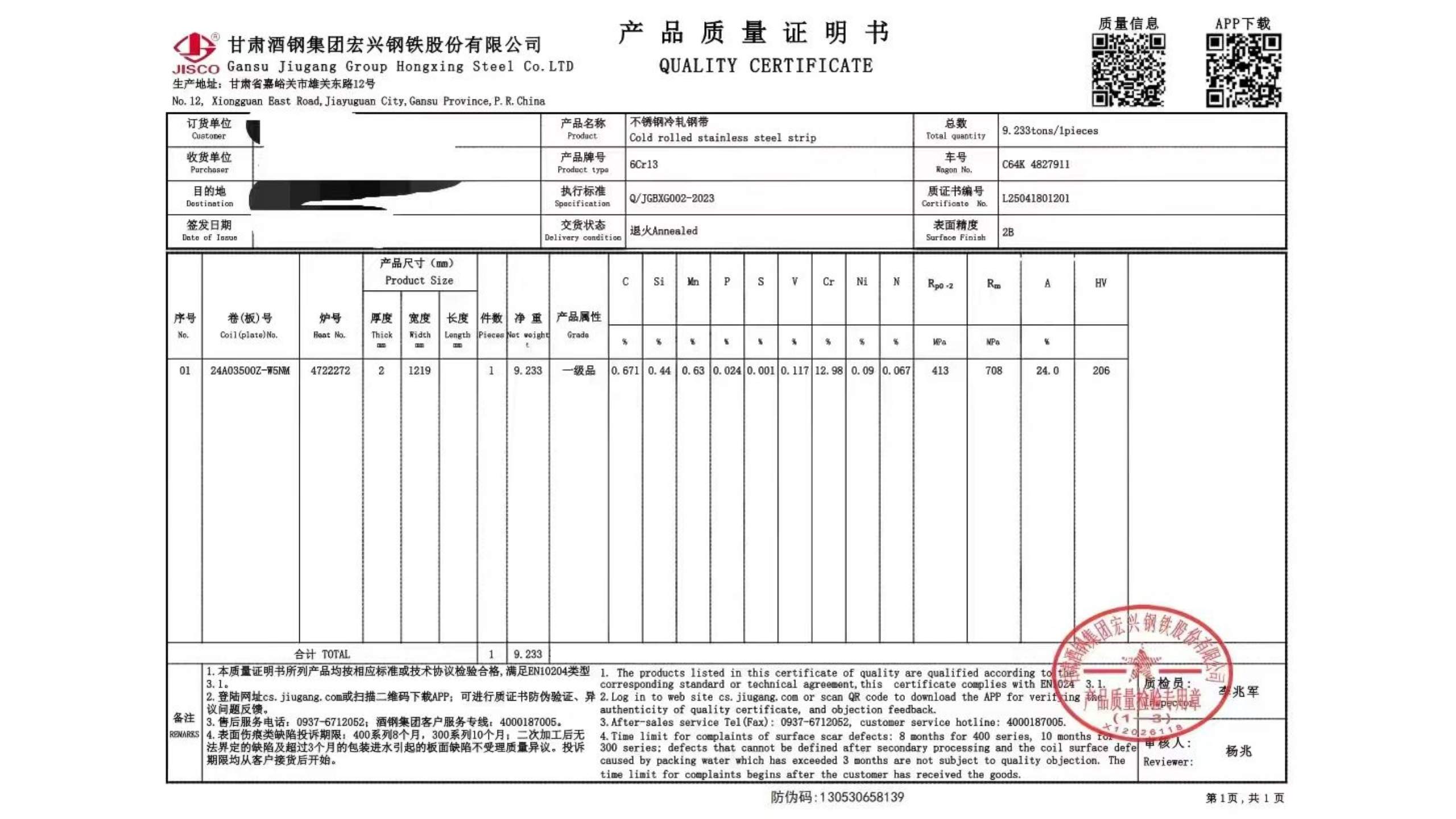
Entscheidend für eine sichere Antwort ist nicht ein abgestempeltes Dokument, sondern Ihr tatsächliches Verständnis des Werksprüfberichts. Dieser Leitfaden verwendet einen realen Werksprüfbericht für kaltgewalztes 6Cr13-Bandstahl der Jiuquan Iron & Steel (Group) Hongxing Steel Co., Ltd. (JISCO) als universelle Vorlage für die Prüfung von Werksprüfberichten. So vermeiden Sie Materialsubstitutionen endgültig.
Warum Sie MTRs lesen und nicht nur sammeln sollten
Edelstahlsorten sehen nahezu identisch aus: 304, 316L, 4106Cr13- und Duplex-Stähle sind mit bloßem Auge kaum zu unterscheiden. Entscheidend für die Eignung eines Werkstoffs sind seine chemische Zusammensetzung und seine mechanischen Eigenschaften – beides ist im Werksprüfbericht dokumentiert.
Wenn Sie lediglich bestätigen, dass ein Zertifikat vorliegt, ohne die darauf enthaltenen Daten zu prüfen, akzeptieren Sie das Material im Grunde blind. Treten später Verwechslungen der Güteklasse oder mangelhafte Eigenschaften auf, liegt die Verantwortung bei der Beschaffung oder der Qualitätskontrolle. Wer einen Materialprüfbericht (MTR) lesen kann, hat in drei kritischen Momenten die Kontrolle:
- Warenannahme: Prüfen Sie, ob das physische Material eins zu eins mit den Dokumenten übereinstimmt.
- Technische Prüfung: Feststellung, ob das Material die Konstruktions- und Betriebsanforderungen erfüllt.
- Audit: Weisen Sie nach, dass Sie Ihre Aufgaben im Bereich der Qualitätsprüfung tatsächlich wahrgenommen haben.
Im Folgenden klären wir zunächst, was ein MTR ist und was er beinhaltet, und gehen dann anhand des 6Cr13-Zertifikats eine praktische Überprüfung durch.
Was ist ein Werksprüfbericht (MTR)? Was genau bescheinigt er?
Ein Werksprüfbericht (MTR) ist ein Qualitätsdokument, das von einem Stahlwerk oder einem autorisierten Hersteller ausgestellt wird und – nach Chargennummer – dokumentiert, ob eine Materialcharge die vorgegebenen Normen für chemische Zusammensetzung und mechanische Eigenschaften erfüllt. Seine Hauptfunktion ist die Rückverfolgbarkeit des Materials und die Zertifizierung der Konformität.
Ganz oben in diesem 6Cr13 MTR finden Sie die folgenden Schlüsselfelder:
- Produzent: Jiuquan Iron & Steel (Group) Hongxing Steel Co., Ltd.
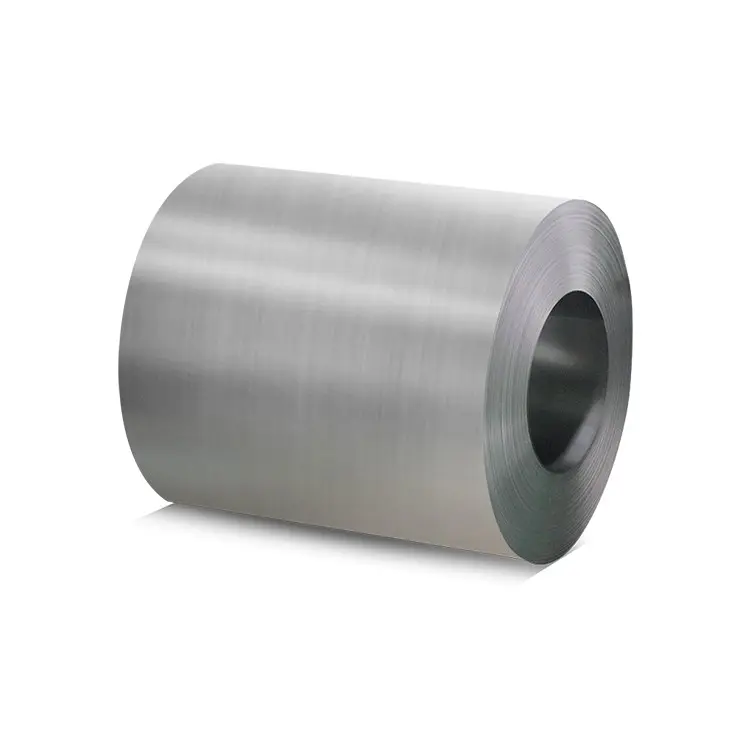
- Produkt: Kaltgewalztes Edelstahlband
- Note: 6Cr13
- Standard: Q/JGBXG002-2023
- Lieferzustand: Geglüht
- Oberflächenbeschaffenheit: 2B
- Gesamtmenge: 9,233 MT
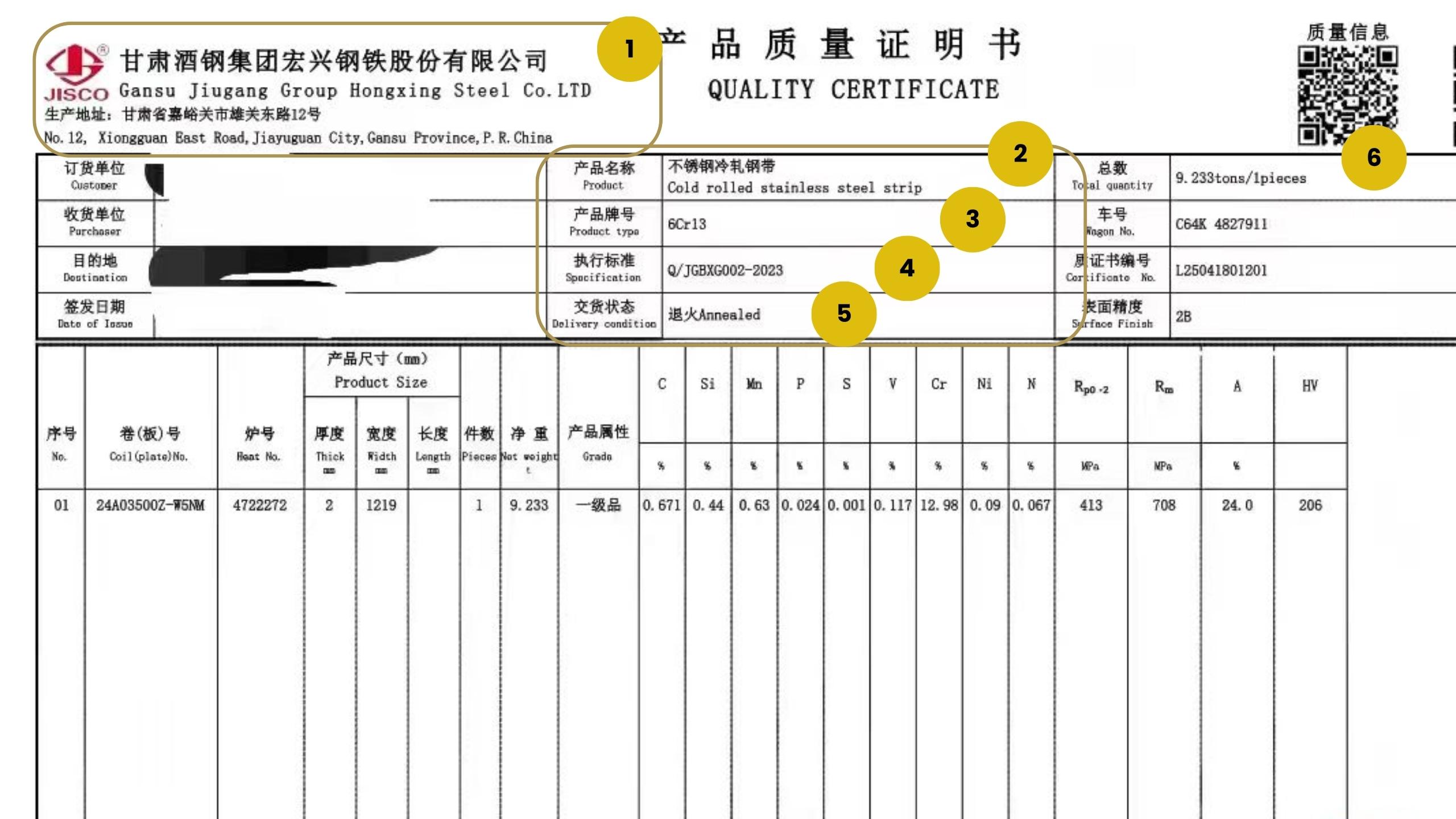
Dies bedeutet, dass die MTR formell Folgendes erklärt: Diese 9,233 MT schwere Spule aus 6Cr13, 2 mm × 1219 mm kaltgewalztem Band wurde gemäß Q/JGBXG002-2023 hergestellt und geprüft. Alle Angaben in den nachfolgenden Tabellen untermauern diese Aussage mit konkreten Zahlen.
Ist ein Materialtestbericht (MTR) dasselbe wie ein Materialzertifikat?
Im alltäglichen Sprachgebrauch werden „MTR“ und „Materialzertifikat“ verwendet. werden oft synonym verwendet — Streng genommen bezeichnet ein Materialprüfbericht (MTR) typischerweise ein vollständiges Rückverfolgbarkeitsdokument mit Chargennummer, gemessenen Prüfdaten und vollständiger Rückverfolgbarkeit, während einige einfache Materialzertifikate lediglich die Angabe „entspricht der Norm X“ ohne unterstützende Daten enthalten.
Die praktischere Art der Beurteilung erfolgt anhand des Inhalts, nicht anhand des Namens:
- Beinhaltet es ein Chargennummer, Spulennummer oder andere Rückverfolgbarkeitskennzeichen?
- Sind darin tatsächliche Messwerte aufgeführt? chemische Zusammensetzung und mechanische Eigenschaften?
- Wird darin spezifiziert? anwendbarer Standard und Zertifikatstyp (z. B. EN 10204 3.1)?
Was passiert, wenn ein Lieferant keinen MTR bereitstellen kann?
Die Antwort ist eindeutig: In praktisch allen industriellen und kommerziellen Anwendungen ist die Verwendung von Edelstahl ohne Original-Werksprüfzeugnis nicht akzeptabel.
Wir haben unzählige Nachrichten von Käufern erhalten, die von chinesischen Händlern betrogen wurden – sie wurden durch niedrige Preise dazu verleitet, Edelstahlspulen ohne jegliche Dokumentation zu kaufen. Sie bestellten 304 Stück und erhielten 201. Als sie den Fehler bemerkten, leugnete der Verkäufer entweder alles oder war spurlos verschwunden.
Bei Laborbauprojekten, der Herstellung chemischer Anlagen oder im Exportgeschäft führt jedes nicht dokumentierte Material dazu, dass das gesamte Projekt die Abnahme verweigert.
Wenn Ihr Lieferant „lose Lagerbestände“ als Grund für die Nichtbereitstellung eines Materialprüfberichts angibt, bedeutet dies wahrscheinlich, dass das Material mehrfach den Besitzer gewechselt hat, die Originaldaten verloren gegangen sind oder es sich schlicht um Ausschussware handelt. Im Falle eines Materialfehlers lässt sich die Verantwortung rechtlich nicht mehr auf den ursprünglichen Hersteller zurückführen.
In dieser Situation haben Sie nur zwei Möglichkeiten:
- Lehnen Sie die Lieferung sofort ab – so vermeiden Sie spätere Produktionsblockaden.
- Prüfung durch ein Drittlabor (PMI): Falls die Verwendung eines solchen Prüfberichts unvermeidbar ist, beauftragen Sie auf eigene Kosten eine unabhängige chemische Zusammensetzungs- und Zugfestigkeitsprüfung und lassen Sie sich einen neuen Bericht ausstellen. Dieser kann jedoch die Aussagekraft eines ursprünglichen Werksprüfberichts (MTR) in der Regel nicht vollständig ersetzen.
Was ist typischerweise in einem Edelstahl-MTR enthalten?
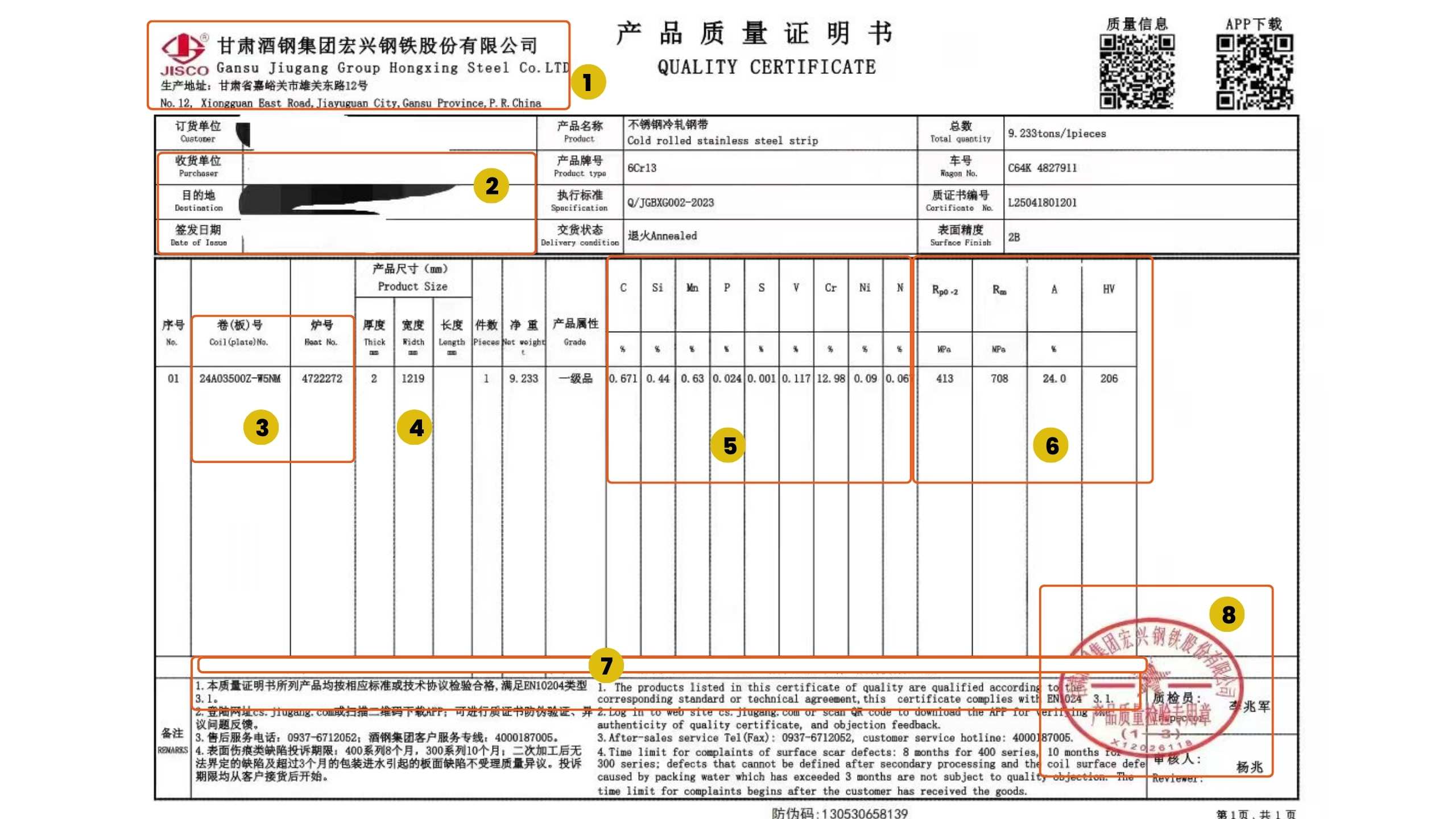
Die Formate variieren je nach Zertifizierungsstelle, die Kernstruktur ist jedoch einheitlich. Anhand dieses 6Cr13-Zertifikats lässt es sich in mehrere Abschnitte unterteilen:
- Header-Informationen: Name des Werks, Adresse, Produktbezeichnung, Güteklasse, Norm, Lieferzustand, Oberflächenbeschaffenheit, Gesamtmenge
- Bestell- und Logistikinformationen: Empfänger, Wagennummer, Zertifikatsnummer, Datum
- Chargenidentifizierung: Spulennummer, Heizstufe, Stückzahl
- Abmessungen und Gewicht: Dicke, Breite, Länge oder Spulengewicht, theoretisches Gewicht
- Tabelle der chemischen Zusammensetzung: C, Si, Mn, P, S, V, Cr, Ni, N und andere Elementprozentsätze
- Tabelle der mechanischen Eigenschaften: Rp0,2 (Streckgrenze), Rm (Zugfestigkeit), A (Dehnung), HV (Härte)
- Konformitätserklärungen: EN 10204 3.1 Erklärung, Kundendienstbedingungen, Reklamationsfrist, Fälschungsschutzcode
- Unterschriften und Stempel: Siegel der Qualitätsabteilung, Zeichnungsberechtigter
Was ist eine Wärmezahl und warum ist sie wichtig?
Die Schmelznummer ist die eindeutige Kennung, die ein Stahlwerk jeder Schmelze zuweist und anhand derer die Produktions-, Prüf- und Qualitätsdaten dieser Schmelze nachverfolgt werden können. Alle Aufzeichnungen zur chemischen Zusammensetzung und zu den mechanischen Eigenschaften sind mit der Schmelznummer verknüpft.
In der Datentabelle dieses 6Cr13 MTR können Sie Folgendes sehen:
- Spulennummer: 24A03500Z-W5NM
- Laufnummer: 4722272
- Dicke: 2 mm
- Breite: 1219 mm
- Stückzahl: 1
- Theoretisches Gewicht: 9,233 MT
Dies bedeutet, dass die Zusammensetzungs- und Eigenschaftsdaten auf diesem Zertifikat nur für „Heizung 4722272, Spule 24A035002-W56M — diese eine 9,233 MT Spule“ gültig sind. Wenn in derselben Sendung eine weitere Chargennummer auftaucht, die diese MTR teilt, ist das ein deutliches Warnsignal.
Sobald Sie diese Abschnitte verstanden haben, verfügen Sie über eine Art Landkarte – Sie wissen genau, wo Sie die einzelnen Informationen finden.
Schritt 1: So bestätigen Sie, dass diese MTR tatsächlich zu Ihrer Sendung passt
Das Erste, was Sie tun sollten, wenn Sie ein MTR erhalten, ist nicht, die Zusammensetzung zu überprüfen – sondern zu vergewissern, dass dieses Dokument dem physischen Material entspricht, das Ihnen vorliegt, und dies zu einer festen Standardvorgehensweise zu machen.
In diesem Auftrag erwarb der Kunde eine Charge kaltgewalzter Edelstahlbänder der Sorte 6Cr13: 2 mm dick, 1219 mm breit, theoretisches Gewicht 9,233 t, hergestellt nach der Norm Q/JGBXG002-2023. Unser Materialprüfbericht (MTR) gibt alle vereinbarten Parameter vollständig und eins zu eins wieder.

- Wird „kaltgewalztes Edelstahlband“ explizit angegeben?
- Ist die Güteklasse als „6Cr13“ angegeben?
- Ist der anwendbare Standard mit dem Vertrag vereinbar (liegt Q/JGBXG002-2023 innerhalb des akzeptierten Projektumfangs)?
- Entsprechen der Lieferzustand (geglüht) und die Oberflächenbeschaffenheit (2B) den technischen Anforderungen?

Im Abschnitt „Produktabmessungen“ ist in diesem MTR Folgendes vermerkt:
- Dicke: 2 mm
- Breite: 1219 mm
- Stückzahl: 1
- Theoretisches Gewicht: 9,233 MT
Vergleichen Sie diese Angaben mit Ihrer Bestellung, der technischen Vereinbarung und dem Produktionsplan, um sicherzustellen, dass Spezifikation, Menge und Gesamtgewicht exakt übereinstimmen.

- Notieren Sie die Spulennummer und die Heiznummer vom MTR.
- Gehen Sie zum Lager und überprüfen Sie die aufgesprühten oder gestempelten Kennzeichnungen auf jeder Spule.
- Bitte überprüfen Sie, ob für jede physische Spule eine entsprechende Wärmenummer und Spulennummer im MTR hinterlegt ist.
Falls eine Spule in der Lieferung eine Chargennummer aufweist, die nicht im Materialprüfbericht (MTR) aufgeführt ist – oder falls ein einzelner MTR versucht, mehrere nicht zusammenhängende Chargen abzudecken –, stoppen Sie sofort den Wareneingang bzw. die Produktion, fordern Sie eine vollständige Dokumentation vom Lieferanten an und entscheiden Sie nach erneuter Bestätigung der Charge, ob Sie die Ware annehmen.
Sobald Sie bestätigt haben, dass die Unterlagen mit dem physischen Material übereinstimmen, können Sie fortfahren. Die wichtigste Frage: Ist das tatsächlich die bestellte Qualität?
Wählen Sie zuerst Ihren Referenzstandard aus.
Die Zusammensetzung lässt sich nicht nach Gefühl beurteilen – man benötigt klare numerische Grenzwerte. Gängige Quellen sind:
- Nationale oder internationale Normen (ASTM, EN, GB, JIS-Anforderungen an die Gütezusammensetzung)
- Die firmeneigenen Standards der Mühle, wie beispielsweise Q/JGBXG002-2023 in diesem MTR
- Zusammensetzungsbereichsklauseln im Kaufvertrag oder in der technischen Projektspezifikation
In öffentlichen Erwähnungen, 6Cr13 wird im Allgemeinen als gleichwertig behandelt mit X6Cr13 / 1.4000, ein martensitischer Edelstahl mit typischen Anforderungen:
- C nicht höher als etwa 0,08%
- Cr im Bereich von 12–14%
- Obergrenzen für Mn und Si
- Strenge Höchstgrenzen für P und S
Sie müssen sich nicht jeden Wert merken – aber verinnerlichen Sie das Prinzip: Jede Note hat einen „zulässigen Bereich“, und der Messwert jedes Elements muss innerhalb dieses Bereichs liegen.
Durchführung einer Zusammensetzungsprüfung an diesem 6Cr13 MTR
Für Wärme 4722272 lauten die Daten zur chemischen Zusammensetzung ungefähr wie folgt:
| Element | Wert |
|---|---|
| C | 0.067% |
| Si | 0.44% |
| Mn | 0.63% |
| P | 0.024% |
| S | 0.001% |
| V | 0.117% |
| Cr | 12.98% |
| Ni | 0.98% |
| N | 0.067% |
Vergleich dieser Werte mit dem Standard:
- C liegt deutlich unter dem oberen Grenzwert, wodurch das Risiko der Sprödigkeit nach dem Aushärten verringert wird.
- Cr liegt im Bereich von 12–14% und gewährleistet somit grundlegende Korrosionsbeständigkeit und Festigkeitspotenzial.
- P und S sind beide niedrig, was zu einer verbesserten Zähigkeit beiträgt.
- Die Zugabe von Ni und N entspricht einer typischen 6Cr13-Chemie
Aus kompositorischer Sicht ist die Identität dieses Materials da 6Cr13 glaubwürdig ist. Bei 304, 316L oder 2205 ersetzen Sie einfach die entsprechenden Standardgrenzwerte und führen Sie die gleiche Prüfung durch.
Woran erkennt man, ob ein Zusammensetzungswert „akzeptabel“ ist?
Ein Wert ist akzeptabel, solange er innerhalb der in der Norm oder technischen Vereinbarung festgelegten oberen und unteren Grenzwerte liegt. Wenn ein Schlüsselelement deutlich unter seinem Mindestwert liegt oder sich genau an der Grenze befindet, kennzeichnen Sie es.
In der Praxis:
- Führen Sie in einer Tabelle den zulässigen Wertebereich jedes Elements zusammen mit seinem Messwert auf.
- Elemente markieren, die „nahe der unteren Grenze“ oder „nahe der oberen Grenze“ liegen.
- Protokollieren Sie diese Grenzfälle separat und veranlassen Sie gegebenenfalls erneute Tests oder bauen Sie eine größere Prozesssicherheitsmarge ein.
Schritt 3: Wie man anhand mechanischer Eigenschaften die Eignung für den Verwendungszweck beurteilt
Die chemische Zusammensetzung verrät Ihnen „Ist das 6Cr13?“ — Antwort auf die mechanischen Eigenschaften „Kann dieses 6Cr13 Ihre Anwendung bewältigen?“
Die vier Schlüsselindikatoren
Auf der rechten Seite dieses Prüfberichts für 6Cr13-Werkstoffe finden Sie:
- Rp0,2 (Streckgrenze): 413 MPa
- Rm (Zugfestigkeit): 708 MPa
- A (Dehnung nach Bruch): 24,0%
- HV (Vickers-Härte): 206
Diese vier Zahlen beschreiben zusammen den Festigkeits- und Duktilitätszustand des Materials.
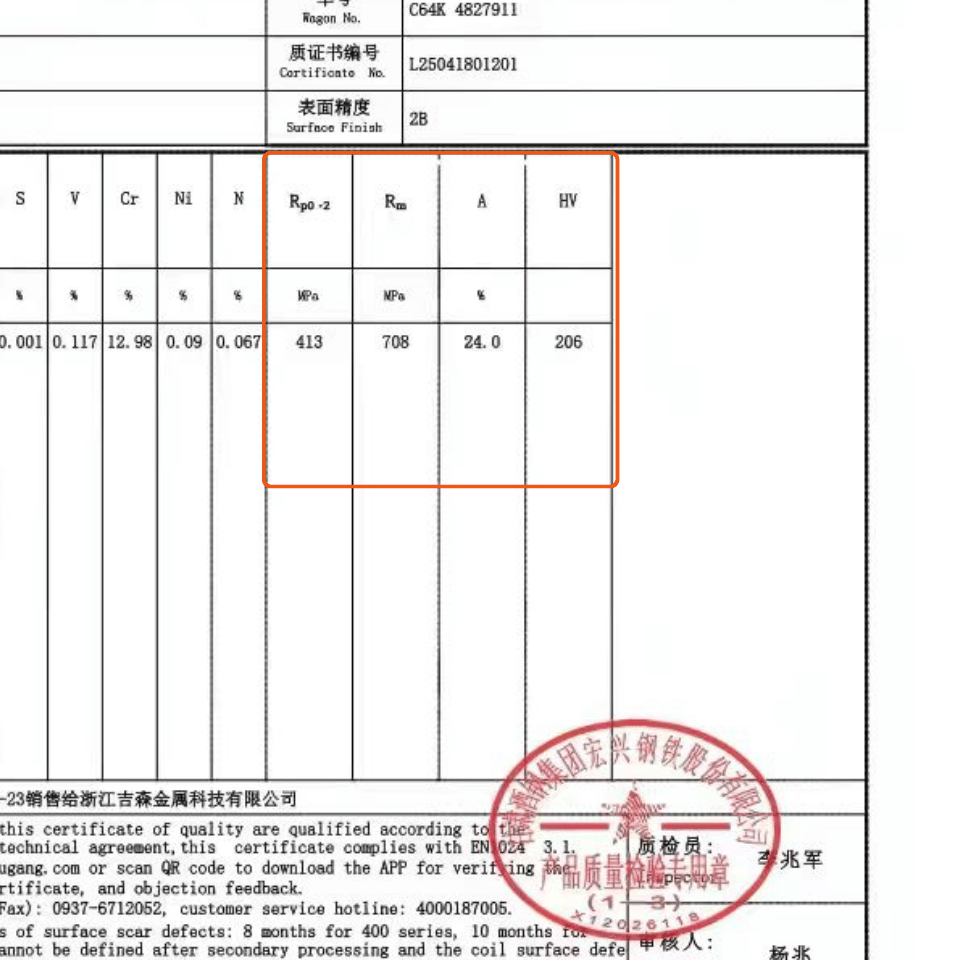
Wie man diese 6Cr13-Eigenschaftsdaten interpretiert
- 413 MPa Streckgrenze weist auf eine solide Tragfähigkeit unter normalen Betriebsbedingungen hin
- 708 MPa Zugfestigkeit liegt im typischen Bereich für martensitischen Edelstahl und eignet sich für viele Struktur- und Schaufelanwendungen.
- 24%-Verlängerung weist eine gute Duktilität für kaltgewalztes Band auf und eignet sich daher gut für das anschließende Stanzen und Biegen.
- Härte HV 206 ist ein üblicher Wert für geglühtes 6Cr13 in vielen Anwendungen
Die eigentliche Aufgabe besteht jedoch darin, diese vier Zahlen anhand zweier Bezugspunkte zu bewerten:
Im Vergleich zu Zeichnungs- oder Konstruktionsvorgaben:
- Welche Mindestwerte für Rp0,2, Rm, A und welche Höchsthärte sind vorgeschrieben?
- Wenn die MTR-Werte deutlich außerhalb dieser Bereiche liegen, konsultieren Sie umgehend den Ingenieur.
Im Vergleich zu historischen Daten für dieselbe Klassenstufe:
- Überprüfen Sie Ihre bisherigen Bestellungen für 6Cr13 MTRs ODER 304, 316.
- Wenn die Streckgrenze oder Härte dieser Charge deutlich über dem historischen Durchschnitt liegt, haben sich die Verarbeitungsbedingungen geändert – ziehen Sie Prozessversuche oder erneute Tests in Betracht.
Was ist wichtiger – Streckgrenze oder Zugfestigkeit?
Bei den meisten Tragwerksplanungen ist die Streckgrenze von größerer Bedeutung. weil es direkt darüber entscheidet, ob sich das Material unter normalen Arbeitsbelastungen dauerhaft verformt. Die Zugfestigkeit wird in erster Linie zur Beurteilung der maximalen Belastbarkeit und der Sicherheitsfaktoren herangezogen.
Bei der Überprüfung eines MTR ist folgende Prioritätenreihenfolge einzuhalten:
- Prüfen Sie, ob Rp0,2 die Mindestanforderung der Zeichnung überschreitet.
- Bestätigen Sie, dass Rm in einem angemessenen Bereich liegt.
- Verwenden Sie Dehnung und Härte gemeinsam, um zu beurteilen, ob Duktilität und Bearbeitbarkeit den Prozessanforderungen entsprechen.
Was bedeutet eine zu hohe oder zu niedrige Härte?
Höhere Härte bedeutet im Allgemeinen größere Festigkeit und Verschleißfestigkeit, aber potenziell auch höhere Sprödigkeit und schwierigere Bearbeitbarkeit. Geringere Härte ermöglicht eine einfachere Bearbeitung, kann aber zu unzureichender Verschleißfestigkeit und Dauerfestigkeit führen.
Zum Beispiel:
- Für Verschleißteile wie Klingen und Lager ist eine höhere Härte vorzuziehen.
- Bei Teilen, die beim Tiefziehen eine erhebliche Verformung erfordern, sind Duktilität und geringere Härte wichtiger.
Dieses 6Cr13 mit einer HV von 206 liegt im akzeptablen Bereich für allgemeine Anwendungen wie Schaufeln, Federn oder hochfeste Strukturbauteile. Für extreme Tiefziehanwendungen ist eine sorgfältige Prüfung erforderlich.
Schritt 4: Beeinflusst der Zertifikatstyp (2.2, 3.1, 3.2) Ihre Materialbewertung?
In den englischen Anmerkungen am unteren Ende des 6Cr13 MTR, Man findet typischerweise eine Aussage in der Art von „Dieses Zertifikat entspricht EN 10204 3.1“, was bedeutet, dass es sich um ein Zertifikat vom Typ 3.1 gemäß dem EN 10204-System handelt, das von der eigenen Qualitätsabteilung des Werks ausgestellt wurde.
Worin besteht der Unterschied zwischen EN 10204 3.1 und 3.2?
Ein 3.1-Zertifikat wird von der Qualitätsabteilung des Herstellers auf Basis interner Prüfdaten ausgestellt. Ein 3.2-Zertifikat erfordert die Mitwirkung einer unabhängigen Prüfstelle oder eines Vertreters des Käufers, der die Ergebnisse bestätigt – es ist mit einer höheren Autorität und strengeren Kontrolle verbunden.
Für Ihren täglichen MTR-Überblick:
- Der Zertifikatstyp ändert nichts daran, wonach Sie suchen oder in welcher Reihenfolge.
- Es hat jedoch Auswirkungen darauf, wer die Verantwortung trägt, wenn etwas schiefgeht, und welche Projekt-Compliance-Anforderungen erfüllt werden.
Für die meisten Standardprojekte ist ein 3.1-Zertifikat ausreichend. Ein 3.2-Zertifikat ist nur für sehr risikoreiche Anwendungen oder streng regulierte Umgebungen erforderlich.
Viele Lieferanten versuchen, ein 3.1-Zertifikat fälschlicherweise als 3.2-Zertifikat auszugeben. Wichtig: Ein echtes 3.2-Werkszeugnis muss zwei unabhängige Prüfzeichen tragen: das Qualitätssiegel des Werks und das Siegel einer unabhängigen Prüfstelle. Selbst wenn auf dem Dokument „Entspricht 3.2“ steht, ist die Angabe „Entspricht 3.2“ unzulässig, wenn nur das Siegel des Werks vorhanden ist.
Zusammenfassung: Die „Lesung eines 6Cr13 MTR“-Methode als universelle Vorlage für jeden Edelstahl
Der Schlüssel zur Aufwertung der MTR-Überprüfung von einem „Bauchgefühl“ zu einem „wiederholbaren Prozess“ liegt darin, die oben genannten Schritte in eine einfache, einseitige Checkliste umzuwandeln und diese konsequent im gesamten Team anzuwenden.
So strukturieren Sie diese Checkliste:
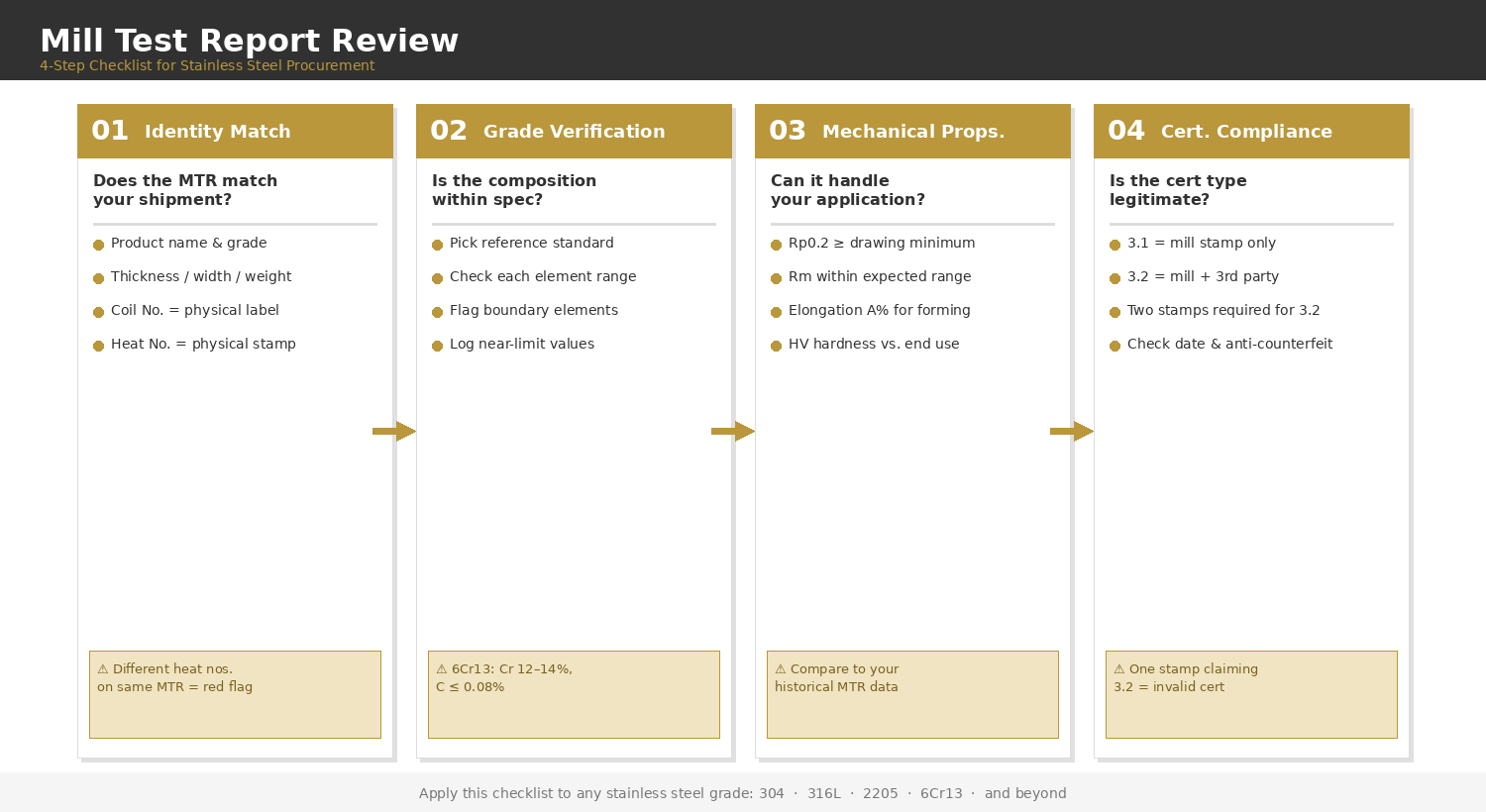
Identitätsbestätigung:
- Produktname, Güteklasse und Norm stimmen mit der Bestellung überein.
- Abmessungen und Menge stimmen überein
- Die Chargennummer und die Spulennummer entsprechen eins zu eins dem physikalischen Material.
Notenprüfung (Zusammensetzung):
- Alle Elemente liegen innerhalb der Grenzen der Standard- oder technischen Vereinbarung.
- Alle Randfallelemente werden identifiziert und protokolliert.
Leistungsnachweis (mechanisch + Härte):
- 2, Rm, A und Härte erfüllen die Zeichnungsanforderungen
- Die Werte liegen innerhalb einer angemessenen Abweichung von den historischen Daten für dieselbe Klassenstufe.
Dokumentenkonformität:
- Der Zertifikatskopf kennzeichnet eine echte Mühle oder einen autorisierten Hersteller.
- Der Zertifikatstyp (3.1, 3.2 usw.) erfüllt die vertraglichen Anforderungen.
- Stempel, Datum und Fälschungsschutzmerkmale sind alle vorhanden
Wenn Lager, Qualitätskontrolle und Einkauf mit derselben Checkliste arbeiten, geht es von „Ein Zertifikat liegt vor, also ist alles in Ordnung“ zu „Ich verstehe die Bedeutung jeder einzelnen Datenzeile und weiß, wann ich Nachfragen stellen oder einen weiteren Test durchführen muss.“ Dieser Ansatz funktioniert nicht nur für 6Cr13 – er gilt gleichermaßen für die Materialprüfberichte (MTR) von 304, 316L, 2205 und allen Duplex-Edelstahlsorten.
Referenzen & Weiterführende Literatur
- Merit Brass – Wie man einen Materialprüfbericht (MTR) und eine Chargennummer liest
Schritt-für-Schritt-Anleitung zum Auffinden und Zuordnen von Chargennummern auf physischen Materialien und MTR-Dokumenten.
https://www.meritbrass.com/blog/how-to-read-a-material-test-report
- Walzstahl – Wie man Walzwerkprüfberichte liest und interpretiert
Systematischer Leitfaden zur MTR-Prüfung, der die chemische Zusammensetzung, die mechanischen Eigenschaften und die Maßverifizierung abdeckt.
https://www.millsteel.com/blog/blog-how-to-read-mill-test-reports
- Evident Scientific – Walzwerksprüfberichte in der Metallverarbeitung: Ein umfassender Leitfaden
Behandelt das Prinzip „Vertrauen ist gut, Kontrolle ist besser“ und die Rolle von PMI-Tests in Verbindung mit der MTR-Dokumentation.
- Holland Applied Technologies – EN 10204 3.1 vs 3.2 Inspektionszertifikate
Übersichtlicher Vergleich aller vier EN 10204-Zertifikatstypen (2.1, 2.2, 3.1, 3.2) mit Definitionen und Anwendungsfällen.
https://hollandapt.com/what-is-the-difference-between-en-10204-3-1-and-3-2-inspection-certificates/
- NTIA – EN 10204 3.1 vs 3.2 Kostenlose Zertifikats-Checkliste (PDF-Leitfaden)
Checkliste zum Herunterladen zur Überprüfung der Echtheit von 3.1- und 3.2-Zertifikaten, einschließlich der Anforderungen an Stempel und Unterschrift.

