
















Why More Engineers Are Moving Away from 304 and Switching to Duplex 2101
You have just received a quotation for a stainless steel storage tank project.
Something feels off. Material cost alone is noticeably higher than it was two years ago. The specification has not changed, the supplier has not changed, yet the budget is getting tighter.
The drawing still says 304, and procurement has always bought 304. But once a project enters a cost-control phase, the team eventually has to face a question it used to avoid: is 304 still the most reasonable default choice?
This article explains why Duplex 2101 is replacing 304 in more industrial tank projects, and under what conditions that substitution is technically reasonable, operationally practical, and economically attractive.
Quick summary
- 304 cost remains sensitive to nickel price volatility, which directly affects tank and equipment budgets.
- Duplex 2101 uses a lean duplex alloy design with much lower nickel content and significantly higher yield strength.
- Its value is strongest in low to moderate chloride projects where thickness reduction, lower welding volume, and lower transport weight may all matter.
- It is not a universal replacement for 304, especially in seawater, high-chloride, or high-temperature aggressive service.
Why is 304 getting more expensive?
The cost of 304 stainless steel has long been closely tied to nickel. 304 became widely used because it offers balanced performance and a mature supply chain, but that also means its price is naturally exposed to nickel market fluctuations.
This was not a major issue when nickel prices were relatively stable. But once raw material prices become volatile, the procurement cost of 304 quickly flows through to storage tanks, structural components, and complete equipment projects, directly squeezing project budgets.
Is the Cost Increase Really Mainly About Nickel?
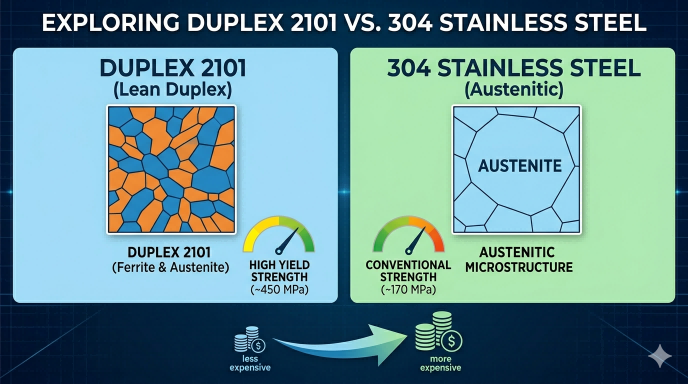
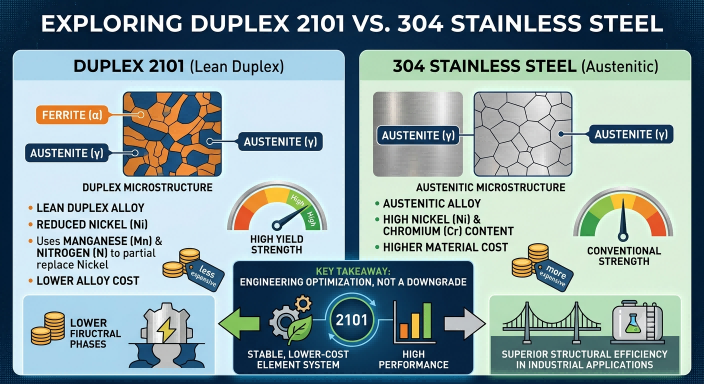
Yes. 304 typically contains more than 8% nickel, while Duplex 2101 contains about 1.5%. That fundamental difference in alloy design means the two grades respond very differently to nickel price swings.
If you are only buying small batches of components, that volatility may not feel dramatic. But in large tank projects, stainless plate is often purchased by the ton, so even a modest price increase quickly turns into a very real budget problem.
What is Duplex 2101, and why is it different from 304?
Duplex 2101 is a lean duplex stainless steel. It uses manganese and nitrogen to partially replace nickel, reducing alloy cost while preserving the high-strength characteristics associated with duplex grades.
Unlike 304, which is an austenitic stainless steel, 2101 has a duplex microstructure made up of both austenite and ferrite. That structure gives it higher yield strength and better structural efficiency in many industrial applications.
Why Is Duplex 2101 Cheaper Without Feeling Like a “Downgraded” Material?
Because 2101 is cheaper mainly due to a different alloying route, not because its performance was simply stripped down. It reduces dependence on high-cost nickel and uses a more stable, lower-cost element system to achieve target performance, so its lower price is better understood as engineering optimization rather than material downgrade.
For buyers, this means three things: lower material cost, lower exposure to nickel price volatility, and easier budget control. That is exactly why 2101 is attracting renewed attention in today’s project environment, where cost reduction and efficiency are under constant pressure.
Want to Know More about Duplex 2101?
Explore MoreKey differences between Duplex 2101, 304, and 316L
If you only look at the grade names, it is difficult to understand why 2101 can replace 304. But once the key parameters are placed side by side, the difference becomes much clearer.
| Property | 304 | 316L | Duplex 2101 |
|---|---|---|---|
| Nickel content | Approx. 8–10% | Approx. 10–14% | Approx. 1.5% |
| Yield strength | Approx. 170 MPa | Typically ≤ 210 MPa | Approx. 450 MPa |
| Typical positioning | General-purpose stainless steel | Higher-corrosion-resistance applications | Cost-efficient lean duplex for industrial use |
| Main value driver | Market familiarity & availability | Extra corrosion margin | High strength & reduced nickel price exposure |
Is Duplex 2101 Really Much Stronger Than 304?
Yes, and the difference is significant. Some research said that Duplex 2101 has a yield strength of about 450 MPa, while 304 is about 170 MPa and 316L is usually below 210 MPa.
Third-party material data sheets point in the same direction: LDX 2101 offers roughly double, and in many cases more than double, the yield strength of standard 304 and 316 grades. That is exactly why it is especially suitable for tanks and structural components: a stronger material makes it possible to use thinner plate under the same design requirements.
Not sure if Duplex 2101 can replace 304 in your next tank project?
Share the basics and get a clear answer.Why do tank projects benefit the most?
In large storage tank projects, plate thickness is not an isolated variable. It directly affects steel tonnage, welding workload, manufacturing lead time, transport weight, and installation cost.
So when a material is both stronger and cheaper, its value is rarely a single-point saving. More often, it creates compounded benefits across the whole fabrication chain.
Can Plate Thickness Really Be Reduced?
In many cases, yes. The comments in the Notion page provide a direct example: a tank that originally required 8 mm plate in 304 may only need 4–5 mm if redesigned with Duplex 2101.
That said, actual thickness reduction must still be confirmed through design calculations and code checks rather than copied mechanically from past examples. The more accurate way to say it is that 2101 creates the possibility of thickness reduction, but does not automatically justify reducing thickness in every project.
If design verification confirms that thickness can be reduced, the project will usually gain the following advantages:
Lower steel purchasing volume.
Fewer welding passes and less filler consumption.
Lower transport weight and easier lifting.
Faster fabrication and delivery.
That is why many budget-sensitive tank projects now evaluate 2101 seriously instead of continuing to treat 304 as the automatic answer.

Quick project impact check
A quick estimate to show how a Duplex 2101 redesign idea may affect project tonnage and decision focus.
Where Is 2101 Suitable, and Where Is It Not?
2101 is not a universal material. It is well suited to a category of industrial environments with clear boundaries, but it is not a drop-in replacement for every stainless steel project.
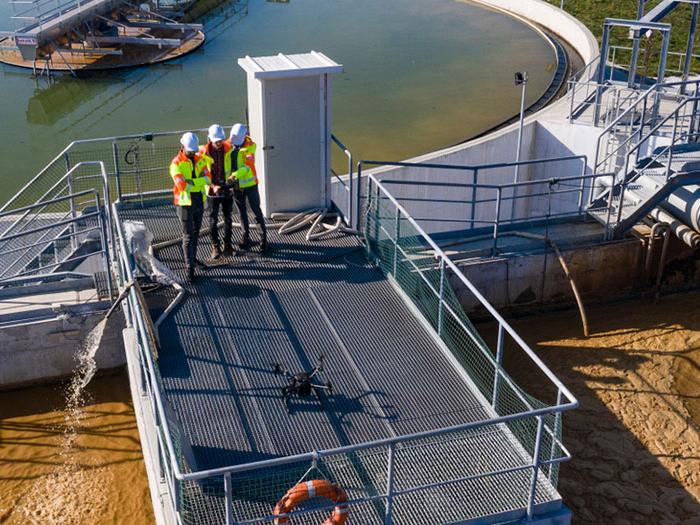
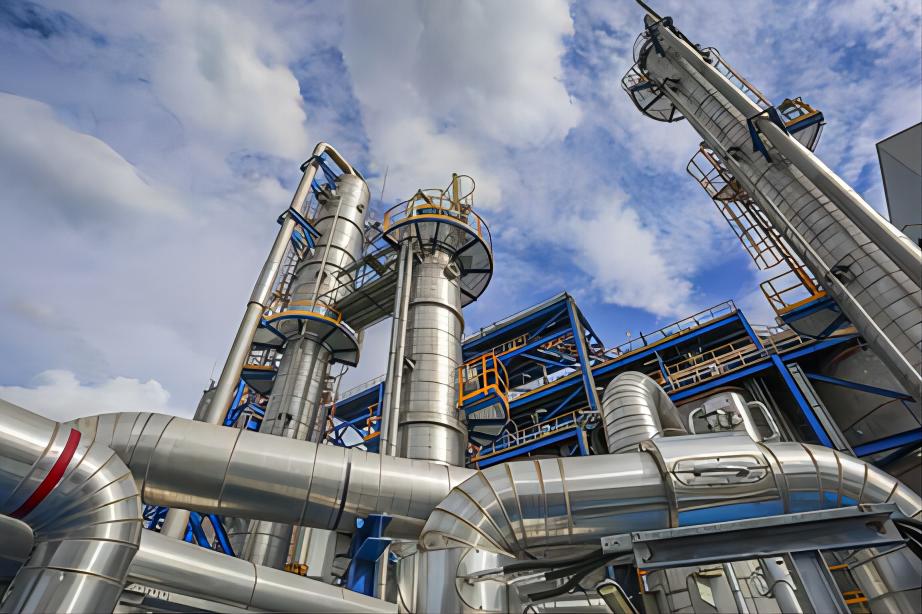
According to the recorded page comments, 2101 is especially suitable for ambient-temperature chemical storage tanks, water treatment equipment, industrial structural parts, transport tanks, municipal engineering, and low-chloride equipment.
What Counts as a “Low to Moderate Chloride Environment”?
In engineering practice, chloride concentrations below 200 mg/L are often treated as low-chloride environments, while 200–1,000 mg/L is often treated as a moderate range. Beyond that, material selection needs more careful evaluation, especially when temperature increases because higher temperature can amplify corrosion risk.
That means industrial freshwater, municipal water systems, and some ambient-temperature process liquids are often closer to 2101’s acceptable range, while seawater, high-chloride media, and high-temperature chloride-bearing services are usually outside its comfort zone.
What Happens If 2101 Is Used in a High-Chloride Environment?
The most direct consequence is a sharply higher risk of pitting and localized corrosion. The Notion page already clearly lists seawater environments, high-chloride media, high-temperature strongly corrosive environments, and extreme chemical media as conditions where 2101 is not recommended.
If a project falls into those categories, 2205, 2507, or super austenitic stainless steels are usually more appropriate choices than trying to force-fit 2101 into the specification. That is not excessive caution; it is simply good boundary management.
Where does the boundary tighten?
A quick screening block for Duplex 2101 under different chloride conditions.
Will welding and fabrication become more difficult?
This is one of the most common concerns among engineers, and also one of the most overstated. Duplex stainless steels do require more attention than 304 in terms of heat input control and filler selection during welding, but that does not mean fabrication shops cannot handle them.
Public data sheets show that LDX 2101 can be welded using established duplex welding practices and is commonly paired with filler metals such as ER2209. Its weldability is mature and practical, not a laboratory-only condition. For fabricators already experienced in stainless steel work, this is usually a process adjustment rather than a complete process rebuild.
In practice, the key points usually include:
Use suitable duplex filler metals such as ER2209.
Control interpass temperature and heat input to avoid microstructural imbalance.
Follow duplex welding procedures for welding, cleaning, and passivation.
These requirements add some front-end process confirmation work, but they are rarely a decisive reason not to switch.
How can you tell whether your project is a good candidate?
The simplest approach is not to start with what others are saying, but with the conditions of your own project. Material substitution should be judged by environmental limits, project scale, and fabrication capability, not by the popularity of a grade name.
A quick initial screen can start with these three questions:
If yes, 2101 usually deserves serious corrosion-performance evaluation. If the project is clearly beyond that range, 2205 or a higher grade should be considered first.
Again, “low to moderate” should not be treated as an empty phrase. It typically refers to low-chloride environments below 200 mg/L and moderate chloride conditions around 200–1,000 mg/L. Once chloride levels rise beyond that, especially when combined with higher temperature or more aggressive media, risk assessment needs to become much stricter.
If the project involves enough tonnage, 2101’s benefits in reduced thickness, reduced welding, and lower transport weight become much more visible. In very small purchases, the total gain from substitution may be less impressive than expected.
This is a very practical question. A process may be technically feasible without necessarily fitting the actual schedule of a project. Still, as long as a fabricator has a basic stainless steel background, this barrier is usually manageable.
If the answer to most of these questions is yes, Duplex 2101 should at least enter your material comparison list rather than being ruled out at the drawing stage.
The most common mistakes when evaluating 2101
What causes many projects to miss the value of 2101 is often not the material itself, but the way it is evaluated. In many cases, this is less a material issue than a decision-making habit problem.
Mistake 1: Assuming Anything Called “Duplex” Must Be More Expensive
This is the most common misunderstanding. Many people hear “duplex stainless steel” and immediately think of high-alloy grades such as 2205 or 2507, so they assume the cost must automatically be higher.
But 2101 was not designed on that logic. It is a lean duplex grade, and one of its core design goals is to achieve a more competitive cost structure through lower nickel content. It should not be grouped automatically into the same “high-price material” category as all duplex grades.
Mistake 2: Changing the Material but Not Recalculating the Thickness
If a project replaces 304 with 2101 but keeps exactly the same plate thickness, it gives up one of 2101’s most important engineering benefits.
The real value of 2101 is not just that the grade name changes. Its higher yield strength may allow meaningful structural optimization. What should happen is a new design verification to see whether thickness can be reduced while still meeting code requirements, rather than simply replacing the material name in the specification.
Mistake 3: Ignoring the Boundary Conditions Behind Pitting Resistance
A short explanation is helpful here. Materials engineers often use PREN, short for Pitting Resistance Equivalent Number, as a rough way to compare how different stainless steels resist chloride-induced pitting corrosion. A higher value usually suggests better pitting resistance, but PREN is more useful for relative ranking between grades than for making a standalone decision about whether a specific project is definitely safe.
So although PREN was not discussed in detail earlier, it is introduced here to help explain why stainless steels that all sound similar can still have very different limits in chloride-containing environments.
The real evaluation mistake is this: some projects stop at the thought that “stainless steel should be enough” without checking the actual medium, chloride concentration, and temperature. The Notion page already warns that 2101 is not recommended for seawater, high-chloride media, high-temperature strongly corrosive environments, or extreme chemical media. In essence, that is a reminder that material boundaries cannot be treated casually.
Mistake 4: Treating Introduction Cost as a Decisive Reason Not to Switch
Some teams worry that switching to 2101 will require process qualification, welding training, or design recalculation, and that these up-front tasks might consume the material savings. That concern is not baseless, but in many projects it is overstated.
A more realistic view is that introduction cost is usually one-time, while material savings and fabrication-efficiency gains can accumulate across future projects. The question that really deserves caution is not “will switching be too troublesome,” but whether the project scale and purchasing frequency are high enough to justify making the switch in the first place.
Why This Is More Than Just Changing One Grade Name
More projects are moving from “default to 304” toward “optimize the material according to actual service conditions.” That shift is not simply a cost-cutting impulse; it reflects a broader change in engineering thinking.
What matters is not only material grade, but total project cost, life-cycle cost, manufacturing efficiency, and future maintenance burden. The Notion page comments make this logic very clear: in many projects that traditionally used 304, 2101 is not just cheaper. It may be the more rational engineering solution.
For large storage tank projects in low-chloride environments, that judgment is becoming more common. 304 is certainly not a bad material, but it is no longer appropriate to treat it as the default answer in every scenario.
Thinking about Duplex 2101 for your tanks?
Thinking about Duplex 2101 for your tanks? Send the service conditions and we will tell you if the switch makes sense.
FAQ
Can Duplex 2101 really replace 304?
In many low to moderate chloride projects, yes. But the replacement should still be verified against corrosion limits, temperature, code requirements, and fabrication capability.
Why is Duplex 2101 often cheaper than 304?
Because it uses far less nickel, so it is less exposed to nickel market volatility and can be more predictable in project budgeting.
Is Duplex 2101 suitable for seawater?
No. Seawater and other high-chloride services are outside its typical preferred range and usually require higher-performance grades.
Does switching automatically mean thinner plate?
No. Switching only creates the possibility of thinner plate. Thickness reduction must still be confirmed by design calculations and code checks.
Sources and further reading
LDX 2101 Grade Data Sheet - Atlas Steels: Official Duplex 2101 material data sheet covering chemical composition, mechanical properties, welding, and applications. Link: Atlas Steels PDF
LDX 2101 Duplex Stainless Steel Data Sheet - Rolled Alloys: Covers 2101 strength, chloride stress corrosion performance, and ER2209 filler recommendations. Link: Rolled Alloys PDF
Duplex Stainless Steel LDX 2101 - Megamex: A practical overview for buyers and engineers, including cost and application scope. Link: Megamex
Duplex Stainless Steel Storage Tanks & Pressure Vessels - Tate Metal Works: Application notes for duplex stainless steels in tanks and pressure vessels. Link: Tate Metal Works
Calculation of Pitting Resistance Equivalent Numbers (PREN) - BSSA: British Stainless Steel Association explanation of PREN and how it is calculated. Link: BSSA
The Pitting Corrosion of Stainless Steel - PREN Values - Anzor: A more accessible explanation of PREN and differences in pitting resistance across grades. Link: Anzor
Pitting Resistance Equivalent Number - Wikipedia: Background reading on the PREN concept. Link: Wikipedia