Is Stainless Steel Too Expensive for Building Construction? A Life-Cycle Cost View
The quote comes in, and once again the stainless steel line is the one that stands out. Its unit price is typically more than 2.5 times that of ordinary low-alloy steel. So on many building projects, stainless steel is the first material to be cut.
But a building or a bridge is meant to last for decades, sometimes more than a century. Can today's quote really tell you what the material will cost?
Stainless steel is not expensive in building construction. When you count the cost over the full service life, and use the right grade selectively in the right places, it saves money and lasts longer.
Key Takeaway: Stainless steel costs more per ton, but in building construction it is often the cheaper choice over its service life: material is only a small share of total cost, and stainless steel saves decades of repair, refurbishment and cleaning labor. The savings depend on selective use. Put it only where corrosion risk is highest or appearance matters most, and choose the grade and finish that just meet the environment: 304 for inland interiors, 316L or molybdenum-bearing ferritic on the coast, and 2205 duplex for seawater immersion.
Why Stainless Steel Isn't Expensive: A Century of Buildings Proves It
Stainless steel has been used in buildings for almost a hundred years. A set of landmark projects from 1929 to today shares one thing in common: decades later, the stainless steel parts are usually the most trouble-free and least costly parts of the whole building. These are also some of the clearest examples of the uses of stainless steel in building construction.
Exterior features: decades without refurbishment
In 1929, the Savoy Hotel in London clad its entrance canopy and sign in stainless steel, widely considered the earliest recorded architectural use of the material. Its first refurbishment came about seventy years later, and it was triggered by a fire at the neighbouring theatre, not by natural ageing. For a hotel whose entrance is its calling card, that meant seventy years without paying to refresh its public face.
The Thyssen building in Düsseldorf was completed in 1960, with its end walls clad in stainless steel panels. More than fifty years later, during a major refurbishment, the entire glass curtain wall was replaced, but the stainless steel cladding only needed cleaning and was kept, saving the cost of removal, transport and reinstallation.

Hard-to-reach areas: get it right once, skip decades of repairs
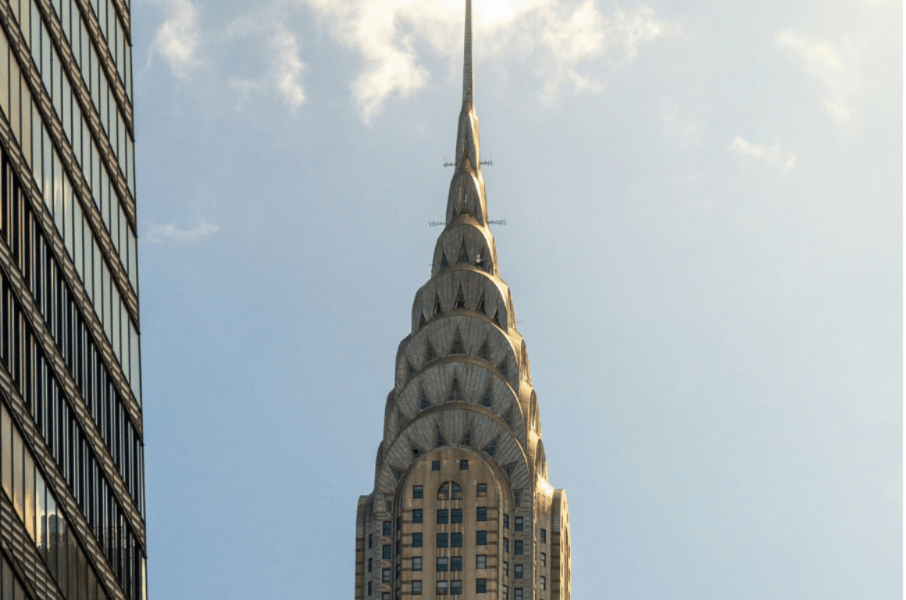
The crown and spire of the Chrysler Building in New York sit about 275 metres above the street and are fully clad in stainless steel sheet. From 1929, the American Society for Testing and Materials used it as a test site and inspected it every five years. By 1960 the inspections were dropped, because there was almost no deterioration to see. Measurements taken during later repairs found almost no loss of material thickness.
At that height, every repair means work at height, closures and risk. Choosing a material that needs almost no maintenance is a saving in itself.
Compared with other materials: stainless steel is rarely what fails
Lever House in New York, built in 1952, is an icon of the early glass curtain wall, with its mullions clad in stainless steel. Decades later the curtain wall failed because the carbon steel behind the mullions took in water, rusted and expanded. When it was repaired in 2001, the new curtain wall still used stainless steel mullions and caps. In the 2023 restoration, the original stainless steel column covers were refurbished and kept in service rather than replaced.
The Atomium in Brussels tells the story even more directly. Its spheres were originally clad in aluminium panels. Forty years later the aluminium had lost its shine and the joints had cracked. During the 2004–2006 renovation, all of it was replaced with stainless steel, chosen for better corrosion resistance and sound insulation.

Harsh environments: other materials have failed, stainless steel is still in service
The Progreso Pier in Mexico was built between 1937 and 1941 and runs two kilometres out to sea. Its concrete contains about 220 tonnes of 304 stainless steel rebar. More than eighty years later it is still in use, while a nearby pier built later with carbon steel rebar is now a ruin. A later life-cycle assessment also concluded that choosing stainless steel was a sound investment.
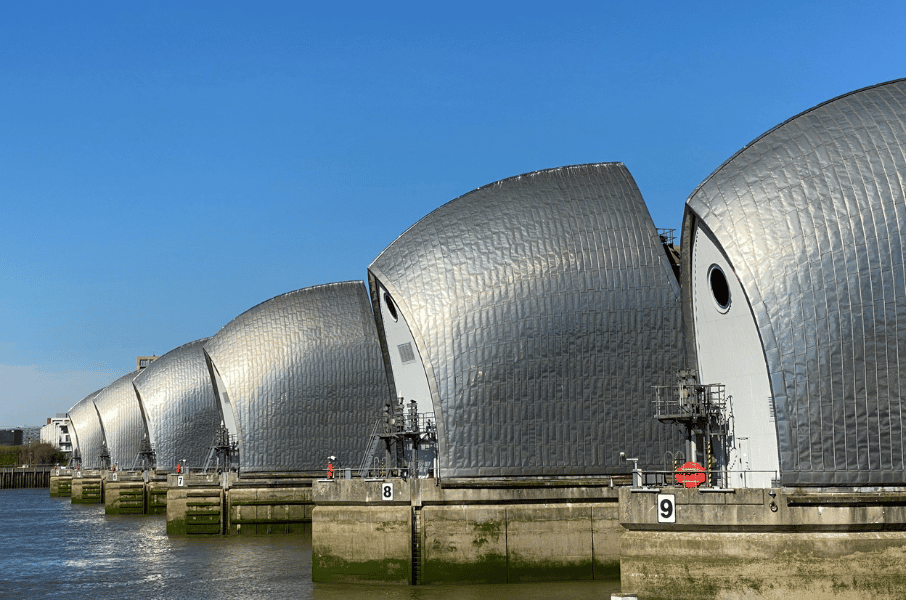
The Thames Barrier in London was completed in 1982. The shell-shaped roofs on its piers are timber structures clad in stainless steel. The engineer in charge said stainless steel was expensive at the time, but in 30 years the roofs had never been cleaned or replaced; had they been built as ordinary flat roofs, they might have been replaced several times already.
All these cases point to the same thing: the cost of a material that needs no repair or replacement for decades cannot be measured by its price on the day you buy it. But most of these savings were only discovered decades later, in hindsight. What happens if you do the math at the design stage?
Doing the Life-Cycle Cost Math at the Design Stage
Looking back, what those buildings saved was mainly the cost of refurbishment, repair and replacement. That is the key to the cost of stainless steel: the unit price is high, but material is only a small share of the total cost. The bigger costs are fabrication and installation, and decades of maintenance afterwards. Put that into the calculation at the design stage, and the choice changes.
How the model works: slightly more up front, cheaper over time
According to the worldstainless Sustainable Materials Modelling study (2024), take a large road bridge as an example and compare two options: one with no stainless steel structural components, and one that uses stainless steel for about 10% of the structural components, only in the deck.
- Material is only a small share of the total cost. In both options, the largest cost is fabrication and installation, not material. So "2.5 times the material price" does not mean "2.5 times the project cost".
- The stainless steel option costs slightly more up front. Both material and installation costs are a little higher.
- The gap opens during maintenance. Without stainless steel, each round of maintenance costs more than the last. With 10% stainless steel, maintenance stays low, and the total life-cycle cost ends up lower.
In other words, using the right stainless steel selectively changes the cost rules of construction.
Three projects that did the math at the design stage
Each of the three projects below calculated the cost over the full service life at the design stage before choosing stainless steel, and the results have since been confirmed:
- Schaffhausen bridge, Switzerland (mid-1990s): Closing this bridge for repairs would cause large-scale detours. The design was built around life-cycle cost, and stainless steel rebar was selected. Overall cost fell by 12%, and the bridge has needed no major maintenance in 30 years.
- AVA modular footbridge, UK (2024): Both the structure and the cladding are made of stainless steel plate and bolted together. Construction cost is more than 30% below a conventional design, with minimal maintenance over a 120-year service life.
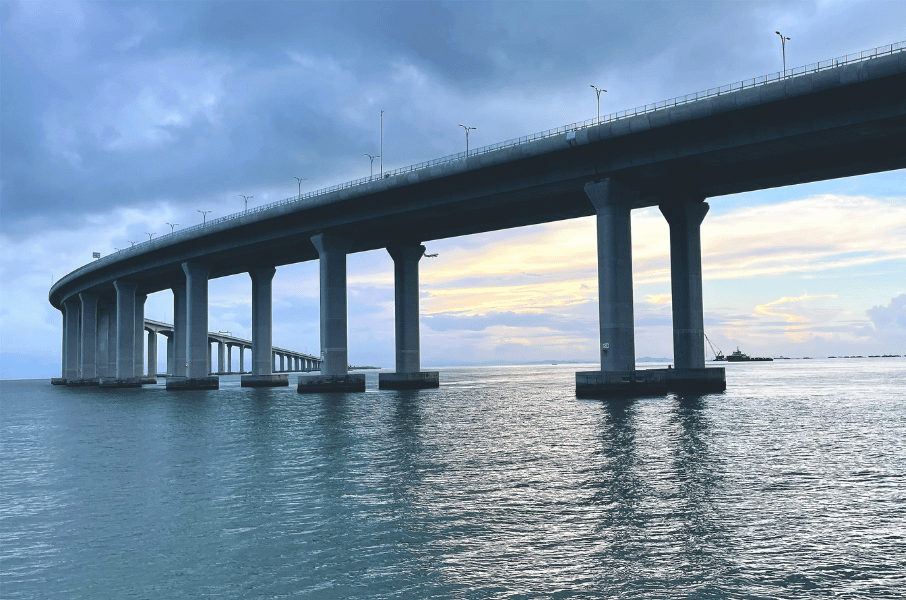
- Hong Kong–Zhuhai–Macao Bridge (2018): Built for a 120-year service life, it uses duplex stainless steel rebar only in critical areas such as the splash zone. Calculations showed this could cut total life-cycle cost by about half.
All three reach the same conclusion: the extra money spent on material is paid back many times over in maintenance and downtime.
Whether you look back at old buildings decades later or at projects that did the math at the design stage, the conclusion is the same: the extra money spent on stainless steel comes back through decades of avoided maintenance and replacement; skipping it to save money may cost far more later.
But this math rests on one condition: stainless steel has to be used in the right places, in the right grade. Use it wrong, and even the best material will not save money.
Use It in the Right Place: Selective Use of Stainless Steel
Stainless steel saves money not by "switching everything to stainless", but by using a just-good-enough grade only where it is needed most. This is selective use, and every project below follows it.
Stainless steel in buildings falls into two broad groups. One carries loads or sits inside the structure, where the risk is corrosion weakening its capacity. The other is the facade and interior finish, where the risk is discoloration, staining and wear that make it look old. Both follow the same principle, but they are measured differently: structural parts by corrosion risk, decorative parts by how long they keep their looks.
Structural Stainless Steel: Use It Only Where Corrosion Risk Is Highest
The most typical approach is to put stainless steel only where corrosion risk is highest. The San Giorgio Bridge in Genoa (2020), which replaced the collapsed Morandi Bridge, stands by the sea, where both air and rain carry salt. Rebar deep inside the concrete is protected; the real danger is near the surface, where water and chlorides arrive first. Once ordinary rebar there rusts and expands, it cracks the concrete and lets corrosion travel deeper. So the design used stainless steel rebar only in these critical areas, such as the pedestrian zones, and kept carbon steel inside the structure. Against about 9,000 tonnes of carbon steel rebar, the bridge added only about 250 tonnes of stainless steel rebar, roughly 3%, and secured long-term safety where it matters most.
"Where it is needed most" is not only where corrosion is worst. It can also be where no other material will do the job. Bush Lane House in London (1976) stood on a site with a height limit to protect views of St Paul's Cathedral. The developer needed as much usable floor area as possible, along with fire protection and low maintenance. The design team built an exoskeleton from 2205 duplex stainless steel, which removed the internal columns and made the floors more open and easier to let. A water-cooling system inside the exoskeleton solved the fire-protection problem of an exposed structure, and the durability of stainless steel met the low-maintenance goal. One material solved three problems at once.
Once the location is right, the next step is the right grade.
What Stainless Steel Grade Is Best for Coastal Construction Projects?
Before choosing a grade, ask four questions. Each one matches a type of corrosion common in buildings:
- Pitting corrosion: Is the project near the coast, in an area that uses de-icing salt, or exposed to airborne chlorides or sulfur pollution?
- Galvanic corrosion: Will different metals be in direct contact?
- Crevice corrosion: Will there be gaps or tight contact surfaces between metal parts?
- Intergranular corrosion: Does the structure involve welding?
The most common measure for choosing a grade is PREN (Pitting Resistance Equivalent Number). It measures an alloy's ability to resist pitting in chloride environments; the higher the number, the better the corrosion resistance:
PREN = %Cr + 3.3 × %Mo + 16 × %N
As a general reference, a PREN of about 22 is the threshold for seawater splash exposure, and about 35 for seawater immersion. Common grades fall roughly as follows:
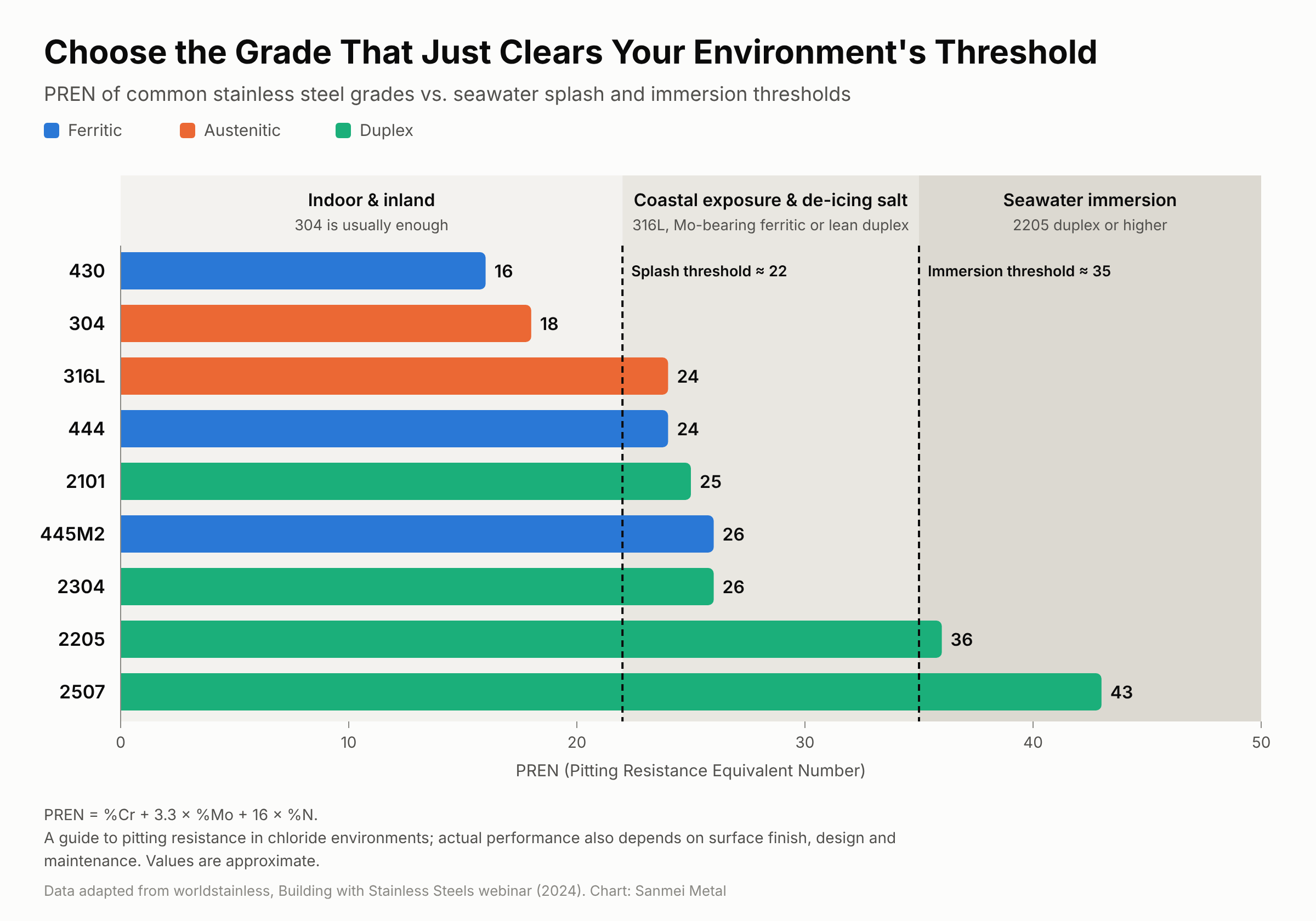
There is only one principle: first identify which threshold your environment calls for, then choose the grade that just clears it. Going far beyond it means paying for corrosion resistance you will never use.
With this principle, the two most common questions answer themselves.
The first: is 316 worth paying more than 304? Only in chloride environments. 304 stainless steel has a PREN of about 18, below the seawater splash threshold; 316L is about 24, just above it. So exposed parts in coastal areas and areas that use de-icing salt should consider 316L or higher, while for indoor projects in inland cities, 304 is usually enough.
The second: must coastal projects use 316? Not necessarily. High-chromium ferritic stainless steels with molybdenum can reach a PREN comparable to 316L, but contain no nickel, so their price is less exposed to nickel price swings. Qingdao Jiaodong International Airport sits about 20 kilometres from the coast and faces strong winds, heavy rain and airborne chlorides, with a design life of more than 80 years. Its roof uses about 1,000 tonnes of ferritic stainless steel containing 22% chromium and 2% molybdenum.
Fasteners and galvanic corrosion
With the right grade chosen, there is one more detail that is easy to overlook: the accessories. When two different metals touch in the presence of water or cleaning agents, galvanic corrosion occurs. The stainless steel is protected, while the zinc, aluminium, ordinary steel, brass or copper in contact with it corrodes faster. Remove any one of the three conditions (different metals, electrical contact, electrolyte) and it will not happen. So when you use stainless steel structural members, always pair them with suitable stainless steel fasteners, especially in coastal construction. One wrong screw can compromise a whole connection, and the savings above are lost.
Source construction-grade stainless steel for your project
Sheet, coil and structural sections in 304, 316L, duplex and ferritic grades, cut and fabricated to your drawings, with a Mill Test Report on every batch.
Decorative Stainless Steel: How Long Can It Keep Its Looks?
For decorative parts, the cost is not structural repair but keeping up appearances: routine cleaning takes labor, and once staining, discoloration or scratches appear, the surface has to be refurbished or even replaced panel by panel. With labor costs rising, both are getting more expensive. The Thyssen building is a case in point: when its glass curtain wall was replaced, the stainless steel cladding only needed cleaning and was kept. So whether decorative stainless steel is worth it depends on how long it keeps its appearance, and at how little labor and maintenance cost.
Where to use it. For decorative work, "where it is needed most" means the places people touch most and look at most: entrances, lobby walls, elevator cars and landing doors, handrails, balustrades and screens. These areas wear fastest and shape a project's first impression. In high-traffic spaces such as shopping malls, airports, metro stations and office lobbies, they are also the surfaces cleaned most often, so a finish that is easy to clean and never needs refurbishing saves real labor every year. Back-of-house areas and surfaces out of sight can use ordinary materials.

Which grade and finish. For decorative parts, grade and surface finish should be chosen together.
In a dry interior, the main risk is not corrosion but wear and fingerprints. Here a nickel-free ferritic grade such as 430 can often replace 304, at a more stable price. The IOTA building in Palaiseau, France, chose by environment: 304 on the exterior, and 1.5 mm bright-annealed 430 on the interior walls.
On the coast and on exposed surfaces, the most common problem is tea staining: a light brown rust film that does not affect the structure but spoils the look. Besides moving up to 316 or higher, the smoother the surface, the less it stains. The Australian Stainless Steel Development Association recommends a surface roughness of around Ra 0.5 µm or lower for exposed coastal applications. A typical No.4 brushed finish is about 0.6 µm; smooth finishes such as 2B and BA already resist tea staining well, and a mirror finish performs best. Design details matter too: open surfaces that rain can wash are less likely to build up salt, while horizontal surfaces, sharp edges and crevices trap water and dirt.
Surface treatments can also extend how long a surface keeps its looks. In high-touch areas, an anti-fingerprint coating helps, and smooth surfaces hold less dirt; both cut how often and how hard the surface needs wiping, which means less labor. Where a specific color is required, PVD coloring creates the color through vacuum deposition, rather than with paint that ages, peels and needs repainting. For outdoor decorative surfaces, whether PVD-colored, brushed or mirror, an additional outdoor protective coating improves weather resistance, extends the life of the surface finish and reduces how often it needs refurbishing.
Stainless steel is low-maintenance, not maintenance-free. The cost logic for decorative parts is the same as for structural ones: use it only where it is most visible and most touched, with a just-good-enough grade and finish, so that for decades it only needs routine cleaning, never refurbishment, keeping both labor and maintenance costs to a minimum.
Stainless steel is durable and cheaper over its life, provided it is used correctly. Yet in practice, many projects agree with all of this and still end up without stainless steel. The reason is usually not technical; it is procurement.
Choosing a finish for elevators, lobbies or facades?
See hairline, mirror, PVD color, etched and embossed sheets side by side. Anti-fingerprint and outdoor protective coatings are available, and we recommend the grade and finish that suit your environment before you specify.
Why Isn't Stainless Steel Used More in Construction?
Because it is hard to buy. Many suitable grades are not traded on the open market and exist only in steel mill supply; project teams often cannot find a local distributor, are not sure which product to buy, and worry about fabrication afterwards. The problem is not the material itself, but the chain from material selection to delivery.
These four concerns are exactly what a factory-direct supplier with its own fabrication capability can solve:
In other words, for selective use to work in practice, someone needs to help the project team solve "what to choose" together with "where to buy it and who will fabricate it", whether it is a small order or bulk purchasing of stainless steel materials for a large construction project.
Need a grade your local distributor doesn’t stock?
Sanmei Metal sources directly from established Chinese mills, fabricates in-house and documents every batch, so you get the right grade, ready-to-install parts and a Mill Test Report from one supplier.
The Bottom Line: Is Stainless Steel Worth the Cost in Building Construction?
Stainless steel does cost more per unit than ordinary steel, but in building construction, counted over its full service life, it is often not expensive. It is clear where the cost comes from, and just as clear where it pays off.
Why the unit price is higher:
- Alloy cost: It contains alloying elements such as chromium, nickel and molybdenum, which cost far more than plain carbon steel. 316 adds molybdenum, so it usually costs more than 304.
- Fabrication requirements: Cutting and welding need suitable equipment and process control; otherwise the material may distort or lose corrosion resistance.
- Price volatility: Swings in raw material prices such as nickel feed directly into quotes.
Why it is often not expensive in buildings:
- Lower life-cycle cost: The total cost of a building material includes purchase, fabrication and installation, and decades of maintenance and replacement; material is usually only a small share. Because stainless steel needs little maintenance and few replacements, its total cost can be lower than that of cheaper materials.
- Durability offsets the unit price: Its corrosion resistance comes from the material itself, not from a coating that wears away, so exposed parts can go decades without refurbishment, as with the 1929 stainless steel canopy of the Savoy Hotel in London.
- Surface treatments extend its looks: Anti-fingerprint coatings reduce routine cleaning, and outdoor protective coatings improve the weather resistance of decorative finishes, so visible surfaces go longer without refurbishment.
- Selective use limits the quantity: The whole project does not need to be stainless. Using it only where corrosion risk is highest or where other materials fall short buys long-term safety for critical areas at a small extra cost. On the San Giorgio Bridge, for example, stainless steel makes up only about 3% of the rebar.
- Matching the grade and finish to the environment avoids waste: The grade and finish only need to meet the environment. For indoor structural use inland, 304 is usually enough, and for interior decoration a ferritic grade can often replace 304; on the coast, 316L or molybdenum-bearing ferritic grades are options, paired with a smooth finish to reduce tea staining.
So stainless steel should be a standard option among building materials, not a luxury considered only when the budget allows.
Considering stainless steel but not sure what to buy, where to buy it or who will fabricate it?
Tell us the location and environment, where the material will be used, appearance requirements and approximate quantity. Drawings help. Sanmei Metal is a stainless steel factory in Foshan, China, with direct access to upstream mill supply. We provide material analysis and selection advice, accept small project-based orders, and support cutting, bending, welding, punching and fabrication to drawings. All materials can be supplied with MTR and SGS quality documents.
Sources
This article is based mainly on the worldstainless webinar below and the studies it draws on, with case background from the following sources:
- worldstainless: Building with stainless steels for a resilient and low-maintenance future (webinar, September 2024)
- worldstainless webinar video (YouTube)
- Outokumpu: Savoy Hotel
- STRUCTURE magazine: Chrysler Building spire
- ArchDaily: Dreischeibenhaus (Thyssen building) refurbishment
- SOM: Lever House
- Atomium: Restoration
- Materials Performance: Progreso Pier (PDF)
- worldstainless: Progreso Pier life-cycle assessment
- The Register: Thames Barrier
- The Engineer: AVA footbridge
- Atlantis Press: stainless steel rebar on the Hong Kong–Zhuhai–Macao Bridge
- Nickel Institute: San Giorgio Bridge
- Mainstream Modern: Bush Lane House
- ISSF: Building interiors – The Ferritic Solution (PDF)
- ASSDA: Seven ways to prevent tea staining of stainless steel